GOLD MARKET FOUNDATION · 14 MIN READ
How is the gold price determined?
No single bank, exchange or dealer sets the continuous global gold price. It emerges from buyers and sellers trading gold and gold-linked contracts across the London over-the-counter market, COMEX futures, exchange-traded products and regional physical markets. The LBMA Gold Price is an important twice-daily benchmark, but it is one defined auction inside a much larger, nearly continuous price-discovery network.
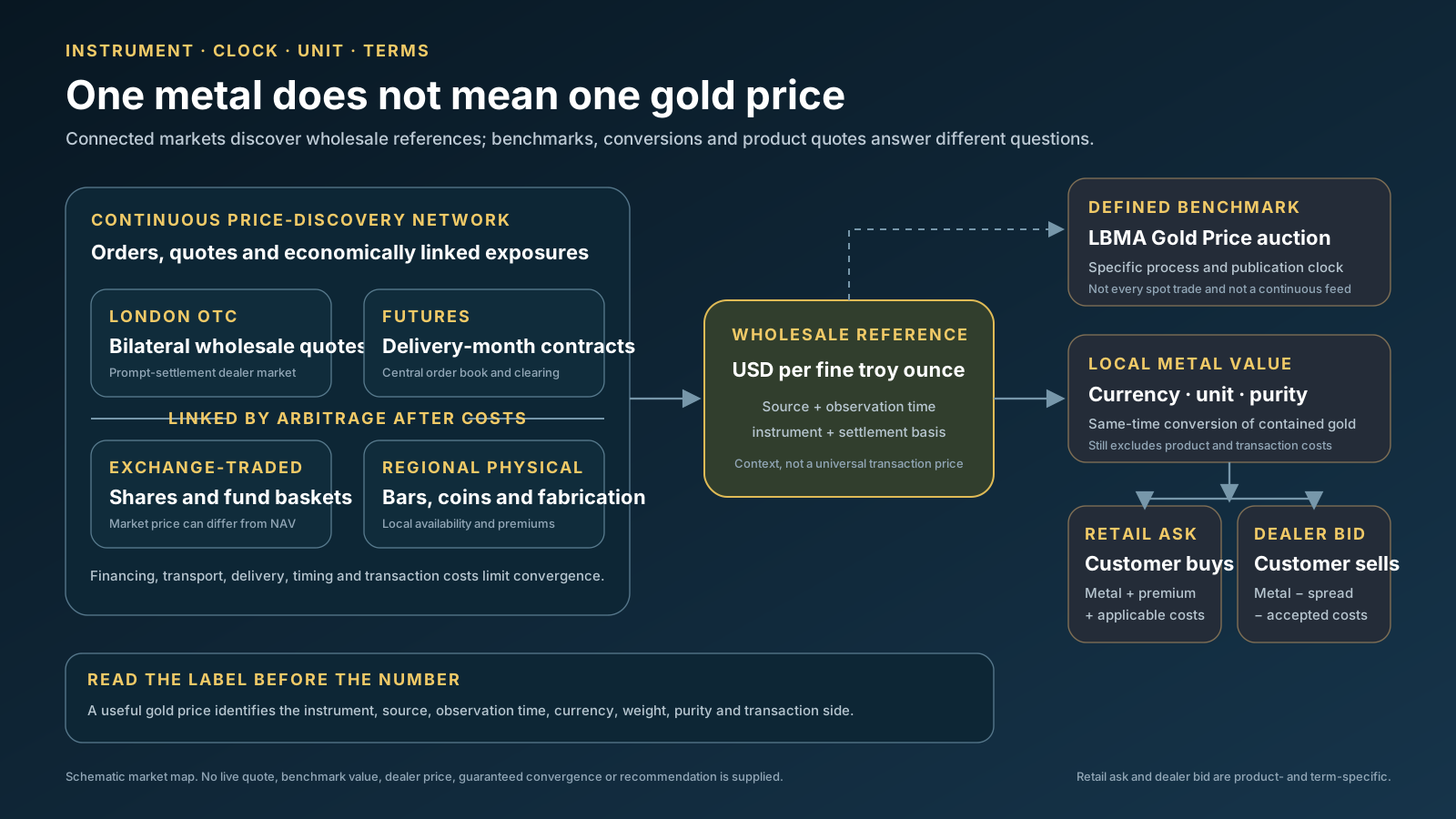
Orders, quotes and arbitrage connect several venues.
Local prices add currency and unit conversion.
A specific electronic auction, not every spot trade.
Premiums and spreads sit outside wholesale spot.

MARKET STRUCTURE MAP
Price discovery, a benchmark and a product quote are different layers
Wholesale venues exchange orders and quotes and are connected by arbitrage after financing, delivery and transaction costs. A defined benchmark auction samples that market under its own rules; currency, unit, purity and product terms then create the number a local buyer or seller actually sees.
INTERACTIVE PRICE CHAIN
From the global reference to a local product quote
Change the currency, weight, purity and transaction assumptions. The tool keeps the wholesale reference, purity adjustment, retail premium and buyback discount separate so one number is never mistaken for another.
Price reference
Shows the source and observation time of the metal price used here. Product premiums, dealer quotes and taxes are separate.
- Source
- No provider
- Observed
- Observation time unavailable
- Age
- Checking age…
- Delivery
- No data layer available
Checking the current market reference.
GoldObserve does not replace a failed provider with a demonstration number.
Premium and buyback values are user-entered illustrations, not dealer quotes. Taxes, fabrication, shipping, assay, storage and payment costs are excluded unless reflected in the entered percentage.
FIVE DIFFERENT PRICES
“The gold price” can refer to different instruments
PRICE DISCOVERY
How the global market reaches a price
Banks, refiners, producers, institutions and other professional participants trade bilaterally in the wholesale market.
COMEX contracts place transparent bids and offers for specific delivery months into a regulated, centrally cleared market.
The LBMA Gold Price auction tests a price against aggregated buying and selling interest until its published tolerance is met.
When economically equivalent prices diverge beyond financing, delivery and transaction costs, professional traders can buy one exposure and sell another.
The London Bullion Market Association explains that ICE Benchmark Administration operates an electronic, tradeable and auditable auction at 10:30 and 15:00 London time. The auction is conducted in US dollars with aggregated anonymous bids and offers. This is different from saying that London “fixes” every gold transaction for the rest of the day.
CME Group describes its precious-metals futures market as a venue for central price discovery, transparency and risk management. Futures prices can differ from spot because they reflect time to delivery, financing, storage and market expectations.
MARKET DRIVERS
What moves gold prices after orders reach the market?
Gold pays no contractual yield. Higher inflation-adjusted yields can make interest-bearing assets more competitive, but risk and currency conditions can override that relationship.
A stronger dollar can make dollar-priced gold more expensive for other currency holders. The inverse relationship is common, not guaranteed.
Financial stress, geopolitical risk and confidence in other assets can change demand for gold, while cash needs can also cause temporary selling.
Large changes in investor positioning can move the marginal price more quickly than annual mine supply changes.
Reserve diversification can affect structural demand, but published purchases do not explain every daily price move.
Income, festivals, price levels and local premiums shape consumer demand across regions.
The World Gold Council’s demand and supply dataset separates jewelry, technology, central-bank and investment demand, and separates mine production, recycling and producer hedging on the supply side. Those categories explain market structure; they should not be turned into a one-variable daily price formula.
SUPPLY MATTERS DIFFERENTLY
Mine production is slow; recycling reacts faster
New mines take years to discover, permit, finance and build, so mine output usually cannot respond quickly to this week’s price. Existing above-ground gold is also enormous relative to annual mine production because gold is durable and repeatedly held or recycled. According to the World Gold Council’s gold-supply overview, mine production typically supplies the largest share of annual flow, while recycling is more immediately responsive to prices and economic shocks.
Short-term prices are set at the margin by executable buying and selling interest; long-run supply constraints can still shape the environment in which that trading occurs.
LOCAL GOLD PRICE
Currency, weight and purity translate the global quote
The final retail or buyback quote then adds or subtracts verified product costs, taxes, dealer margin and transaction spread.
A local gold price can rise even when XAU/USD is flat if the local currency weakens against the dollar. The reverse is also possible. Comparisons therefore need a matching timestamp, the same weight definition and the same purity. One troy ounce is 31.1034768 grams; it is not the 28.3495-gram ordinary ounce.
WORKED EXAMPLE
Why a 22K product quote is not the spot price per gram
At $2,400 per troy ounce, pure gold is about $77.16 per gram.
Multiplying by 22 ÷ 24 gives about $70.73 of contained gold per gross gram.
A 6% product premium produces an illustrative ask near $74.97 per gross gram before other costs.
A dealer paying 3% below metal value would bid about $68.61 per gross gram, before testing or transaction fees.
These numbers demonstrate the method only. Use the live tool above and a real dealer quote for a current comparison.
COMMON MISCONCEPTIONS
Four shortcuts that lead to weak gold analysis
ANALYSIS CHECKLIST
How to explain a gold-price move responsibly
01Define the instrument: spot, benchmark, futures, ETF or physical product.
02Confirm currency, weight, purity, source and observation time.
03Compare real rates, the dollar, risk conditions and investment flows over the same period.
04Check whether local currency translation explains the local price move.
05Separate evidence of co-movement from a claim of causation.
06State what would falsify the explanation and which data remain unavailable.
PRIMARY SOURCES & METHOD
Where the market definitions come from
- LBMA Gold Price FAQs for auction operation, schedule, currency and licensing boundaries.
- CME Group precious-metals market for futures price discovery, clearing and market structure.
- World Gold Council demand and supply data for sector and supply-category definitions.
- GoldObserve data methodology for quote normalization, unit constants, source labels and unavailable states.
GoldObserve does not republish the licensed LBMA benchmark series on this page. The interactive reference uses the provider named inside the tool. Market explanations describe mechanisms and historical evidence, not a deterministic valuation model or investment recommendation.
RELATED RESEARCH
Test each major channel with data
FAQ
Questions about how gold prices are set
Who sets the price of gold?
No single person or institution sets the continuous global price. It emerges from trading and arbitrage across wholesale, futures, exchange-traded and physical markets.
Is spot gold the same as the LBMA Gold Price?
No. Spot is a current wholesale market reference. The LBMA Gold Price is a defined benchmark produced through an electronic auction twice each London business day.
Why is a gold coin more expensive than spot?
The coin price can include fabrication, minting, distribution, inventory, payment, shipping and dealer margin on top of contained metal value.
Do central banks control gold prices?
No. Their reserve purchases or sales can affect demand, expectations and market structure, but they do not mechanically dictate every market price.
Why does gold move when interest rates change?
Real yields alter the opportunity cost of holding a non-yielding asset. The effect can be offset by inflation expectations, currency moves, risk demand and positioning.