THE SHORT ANSWER
Gold and the dollar often move opposite ways, but the relationship is conditional
Gold is normally quoted in US dollars, while the dollar is itself a reserve, liquidity and interest-bearing alternative. A stronger dollar can make USD gold more expensive for foreign buyers and often accompanies higher opportunity costs. A weaker dollar can provide support. Yet real yields, crisis liquidity, central-bank buying, physical demand and investor positioning can overwhelm that channel. The right test is not “did the dollar rise?” but “how often, how strongly and under which regime did the two assets diverge?”
Positive = local currency weakens.This is a translation sensitivity, not a forecast for a named currency.
TRANSMISSION MAP
Trace the dollar channel without turning it into a forecast
A dollar move reaches gold through several channels at different speeds. Real yields, risk demand, liquidity and market positioning can reinforce or offset the currency translation effect, so the map is a framework for investigation rather than a directional signal.
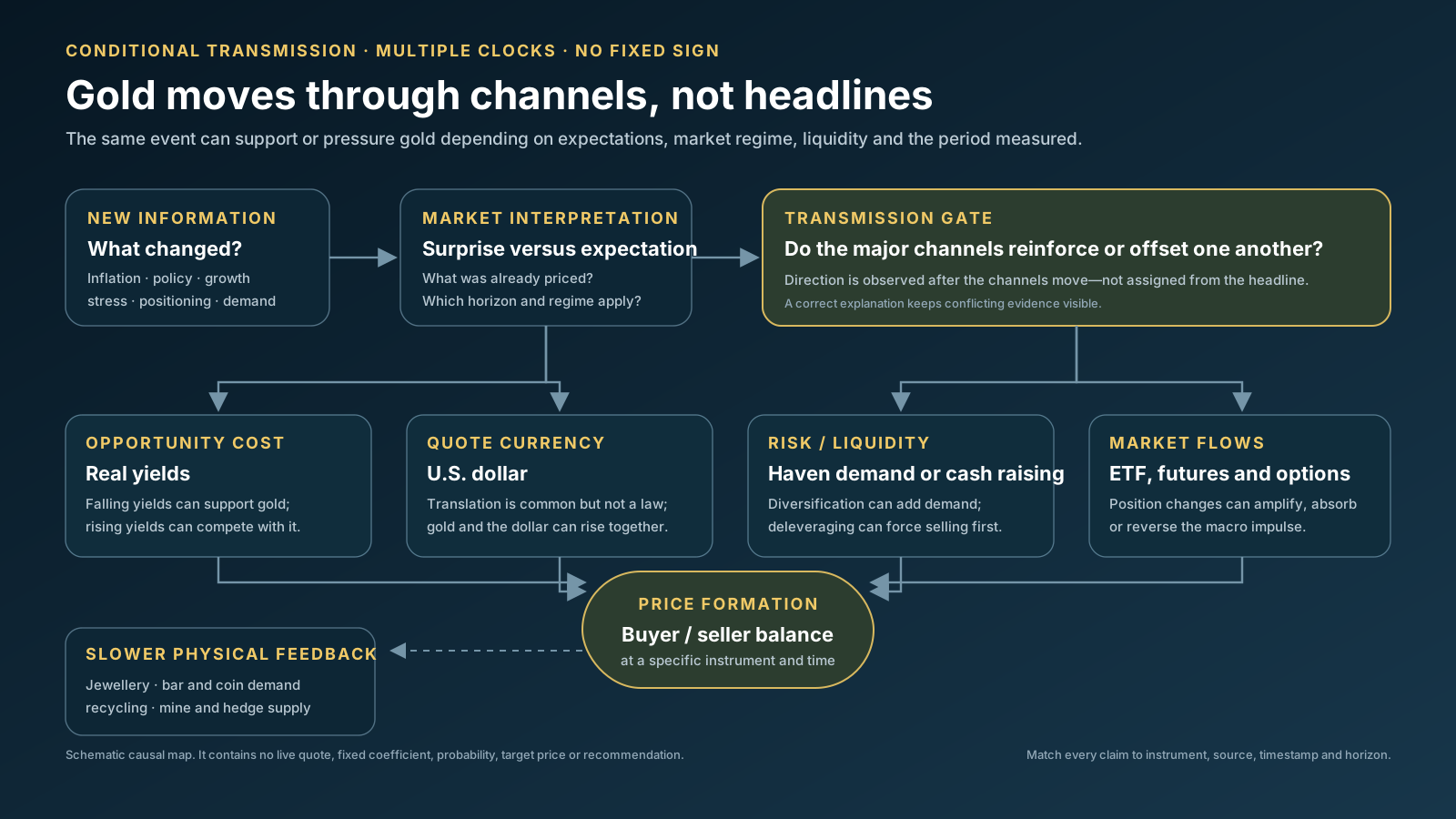
Interpretation boundary: The diagram does not establish causation, forecast the next gold price or replace matched-date data. Check the selected benchmark, sample and observed series before drawing a conclusion.
BENCHMARK DEFINITION
The broad US dollar index is not DXY and not a dollar price
GoldObserve uses the Federal Reserve Board’s nominal broad US dollar index, distributed by FRED as DTWEXBGS. It is a trade-weighted average against currencies of major US trading partners and is indexed to January 2006 = 100. An observation of 120 means the weighted index sits 20% above its base level; it does not mean one dollar is worth $1.20. The Federal Reserve periodically revises trade weights as trade patterns change.
WHY THE LINK EXISTS
Three mechanisms connect the dollar and gold
A dollar move changes the price faced by buyers using other currencies, all else equal.
A stronger, higher-yielding dollar can compete with a non-yielding metal.
During stress, investors may demand dollars and gold together or sell gold to raise dollars.
Reserve diversification can support gold even when the broad dollar index rises.
FOUR REGIMES
The same currency move can lead to a different gold outcome
Currency translation or lower opportunity cost may be supporting gold.
Capital may prefer dollar assets while foreign gold purchasing power weakens.
Stress, inflation concern or reserve diversification may support both.
Liquidation, weaker demand or positioning can outweigh currency support.
The tool reports the share of exact-date intervals in which the two series moved opposite ways. That number is more honest than calling the relationship “always inverse,” but it still depends on the range and observation frequency and does not establish that the dollar caused a gold move.
LOCAL-CURRENCY TRANSLATION
A non-US investor owns gold and an exchange-rate exposure
Units, price time and FX convention must match.
The effects compound rather than simply add.
A weaker local currency increases the translated gold price, all else equal.
If USD gold gains 10% while the local currency weakens 10% against the dollar, the modeled local return is 21%, not 20%. Conversely, a stronger local currency can reduce or erase a USD gold gain. The tool uses a hypothetical input so it does not misrepresent a stale or unrelated live exchange rate.
WHAT BREAKS THE PATTERN
Six reasons gold can ignore a dollar move
METHOD
What the data lab measures and deliberately omits
The tool keeps gold in USD per troy ounce and matches it to DTWEXBGS only when the same calendar date appears in both source series. It does not forward-fill weekends or holidays. Both levels are rebased to 100. Pearson correlation uses paired simple returns, while volatility uses the actual calendar span of the matched observations. Maximum drawdown is the deepest peak-to-trough decline inside the selected sample.
Exact dates do not guarantee identical collection times. The analysis excludes intraday movement, execution prices, dealer premium, tax, product fees and local-market frictions. FRED shows the current published series and can revise observations or weights. GoldObserve reports an unavailable state rather than manufacturing a result.
DECISION CHECKLIST
How to investigate a claim that “the dollar moved gold”
01Name the exact dollar benchmark; do not use “DXY” and “the dollar” interchangeably.
02Match dates, frequency and observation conventions before comparing returns.
03Inspect the buyer’s own local-currency gold result, not only USD gold.
04Check real yields, nominal yields and inflation compensation for a shared cause.
05Review risk conditions, central-bank demand, physical flows and positioning.
06State what evidence would reverse the interpretation and avoid turning correlation into causation.
PRIMARY SOURCES
Official benchmark definitions and data
RELATED RESEARCH
Build a complete opportunity-cost view
FAQ
Gold and US dollar questions
Does gold always rise when the US dollar falls?
No. A weaker dollar is often supportive, but real yields, liquidity, physical demand, central-bank buying and positioning can dominate.
Is the Federal Reserve broad dollar index the same as DXY?
No. They use different currency baskets, weights and methodologies. GoldObserve uses the Federal Reserve nominal broad index and names it explicitly.
Can gold and the dollar rise together?
Yes. Both may attract defensive demand during severe stress, or gold-specific demand can outweigh a stronger dollar.
Why does the chart rebase both lines to 100?
Gold is quoted in dollars per ounce while the dollar series is an index. Rebasing compares percentage paths without implying that unlike raw units are comparable.
What does a negative correlation mean?
It means changes tended to move in opposite directions inside the selected sample. It does not prove causation or guarantee the relationship will persist.
Why can local-currency gold differ from USD gold?
A local gold quote combines the USD gold move with the change in local-currency units per US dollar. The effects compound rather than simply add.
Does the local-currency scenario use a live exchange rate?
No. It is a user-controlled sensitivity test. It does not claim to represent a named currency, forecast or executable quote.
Are missing dollar-index dates estimated?
No. Only exact dates found in both source series enter the analysis. Missing dates are omitted rather than forward-filled or interpolated.