CURRENCY AND GOLD GUIDE · 15 MIN READ
Gold has a global price and a local currency experience
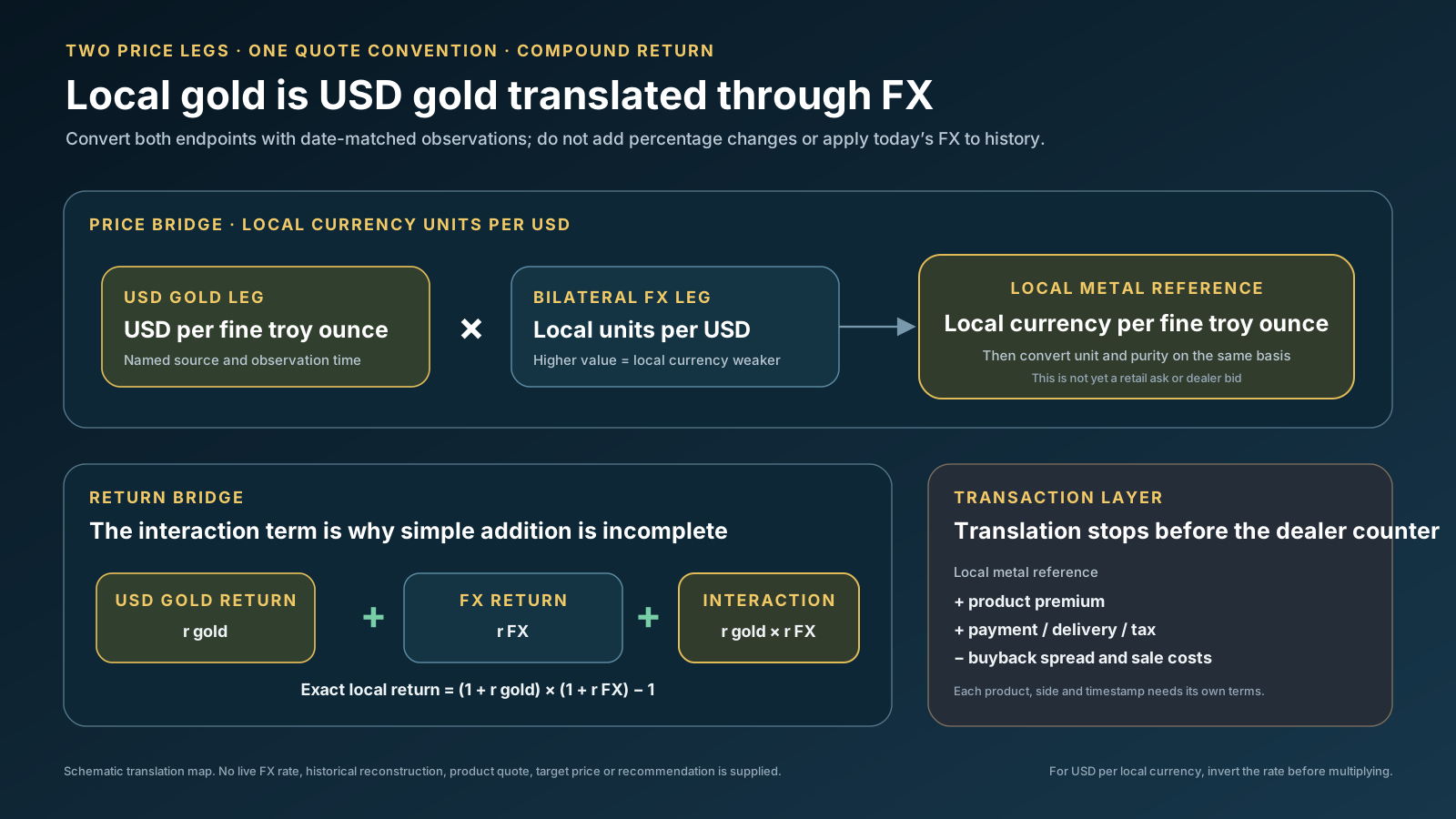
Gold is commonly quoted in U.S. dollars, but a buyer's local gold price combines the USD gold price with the bilateral exchange rate. If USD gold is unchanged while the local currency weakens 8% against the dollar, local gold rises about 8% before premiums and costs. If USD gold rises 5% and the local currency weakens 8%, the exact local return is 13.4%, not 13%, because the two changes compound. A stronger local currency can reduce or erase a USD gold gain.
Each U.S. dollar costs more local currency.
Fewer local units are needed per dollar.
Use the exact multiplicative formula.
Rates, risk, demand and flows also matter.
TRANSLATION AND RETURN BRIDGE
Two date-matched legs create the local gold result
Use USD gold and the bilateral rate from the same start and end dates. The diagram separates price translation, compound return and the later product-cost layer so today's FX is never used to manufacture historical local prices and a metal reference is never mistaken for a dealer quote.
INTERACTIVE FX WORKBENCH
Translate USD gold into a local-currency return
Enter starting and ending USD gold prices plus the exchange rate in local currency units per U.S. dollar. The tool calculates both legs, their compound interaction and the resulting local price per ounce.
Enter comparable gold and exchange-rate values
Use the same dates and one consistent exchange-rate convention.
Local return = (1 + USD gold return) × (1 + local-currency-per-USD return) - 1.
Market translation only. Physical premiums, dealer spreads, tax, delivery, storage and observation-time differences are not inferred.
CORE FORMULA
Local gold price equals USD gold multiplied by FX
Example: $2,400 per ounce × 7.00 local units per USD = 16,800 local units per ounce.
With +5% USD gold and +8% local-currency-per-USD, the result is 1.05 × 1.08 - 1 = 13.4%.
Adding the two percentage changes is only an approximation. The difference is the interaction term: gold return multiplied by FX return.
QUOTE CONVENTION
First determine which side of the exchange rate is rising
Never apply a formula before checking the quote direction. EUR/USD and USD/JPY, for example, place the U.S. dollar on opposite sides of the notation.
FOUR MARKET PATHS
The same USD gold move can produce different local outcomes
The local return exceeds the USD gold return because the effects compound.
A large enough strengthening can erase the USD gold increase.
Local gold may fall less, stay flat or rise.
The local decline can be larger than the USD decline.
BROAD DOLLAR VS. BILATERAL FX
A dollar index cannot replace the investor's own currency pair
The Federal Reserve's nominal broad U.S. dollar index is a trade-weighted average against currencies of major U.S. trading partners. Its weights are revised periodically. It is useful for global dollar context, but it is not the exchange rate experienced by a buyer using euros, rupees, yen or another one currency.
WHY USD GOLD AND THE DOLLAR DIVERGE
A stronger dollar is a common headwind, not a mechanical rule
A stronger dollar can make USD-priced gold more expensive for non-U.S. buyers and can coincide with tighter financial conditions. But both gold and the dollar can rise during stress, and gold-specific demand can outweigh currency translation.
LOCAL PRICE IS NOT RETAIL PRICE
Currency translation stops before the dealer counter
The translated metal price is a market reference. A physical product can add fabrication premium, dealer spread, delivery, insurance, storage, tax and local supply conditions. During currency stress, product premiums and market access can change at the same time as FX.
Compare a same-time dealer bid as well as the ask before treating the reference price as executable.
ANALYSIS WORKFLOW
Seven checks for a defensible currency explanation
01Record USD gold price, bilateral FX rate, currency convention and exact dates.
02Convert both start and end prices before calculating the local return.
03Separate USD gold return, FX return and the compound interaction.
04Compare observation times and omit unmatched or unavailable values.
05Name any broad dollar index and its methodology.
06Check real yields, risk, flows and physical demand for competing explanations.
07Add premiums and costs only when modelling a real product transaction.
PRIMARY SOURCES & METHOD
Official currency definitions used here
- Federal Reserve H.10 dollar-index summary for broad, advanced-economy and emerging-market index definitions.
- Federal Reserve currency weights for the current broad-index composition and revision framework.
- FRED nominal broad U.S. dollar index for the daily public series and January 2006 = 100 unit.
- LBMA auction price documentation for the USD gold benchmark and indicative settlement currencies.
- GoldObserve methodology for gold sources, timestamps, conversions and unavailable states.
RELATED DATA & TOOLS
Move from translation to market evidence
FAQ
Currency and gold price questions
Why can gold rise locally when USD gold is flat?
A weaker local currency raises the local cost of each U.S. dollar.
Does a stronger dollar always make gold fall?
No. Rates, risk demand, central-bank buying, physical demand and positioning can offset it.
Why is the exact local return not a simple sum?
Gold and FX multiply, creating a compound interaction term.
Is the broad U.S. dollar index the same as DXY?
No. Currency baskets, weights and methodologies differ.
Does the formula include retail premium?
No. It translates the metal reference price; product and transaction costs are separate.