GOLD PRICE FOUNDATIONS · 13 MIN READ
Spot gold price vs. futures price
Spot gold and gold futures describe different transactions. Spot is a wholesale reference for prompt settlement; a futures price is today’s tradable price for a standardized contract tied to a specified delivery month. Their difference is the basis. Financing, storage, insurance, time to expiry, liquidity and hedging pressure can all affect that basis, so a futures quote should not be read as a simple prediction of where spot gold will trade at expiry.
A current market reference, commonly quoted in US dollars per troy ounce.
The quote belongs to a named delivery month and exchange rulebook.
A dollar difference that must be interpreted with time and carry costs.
Today’s contract price contains more than an expected future spot level.
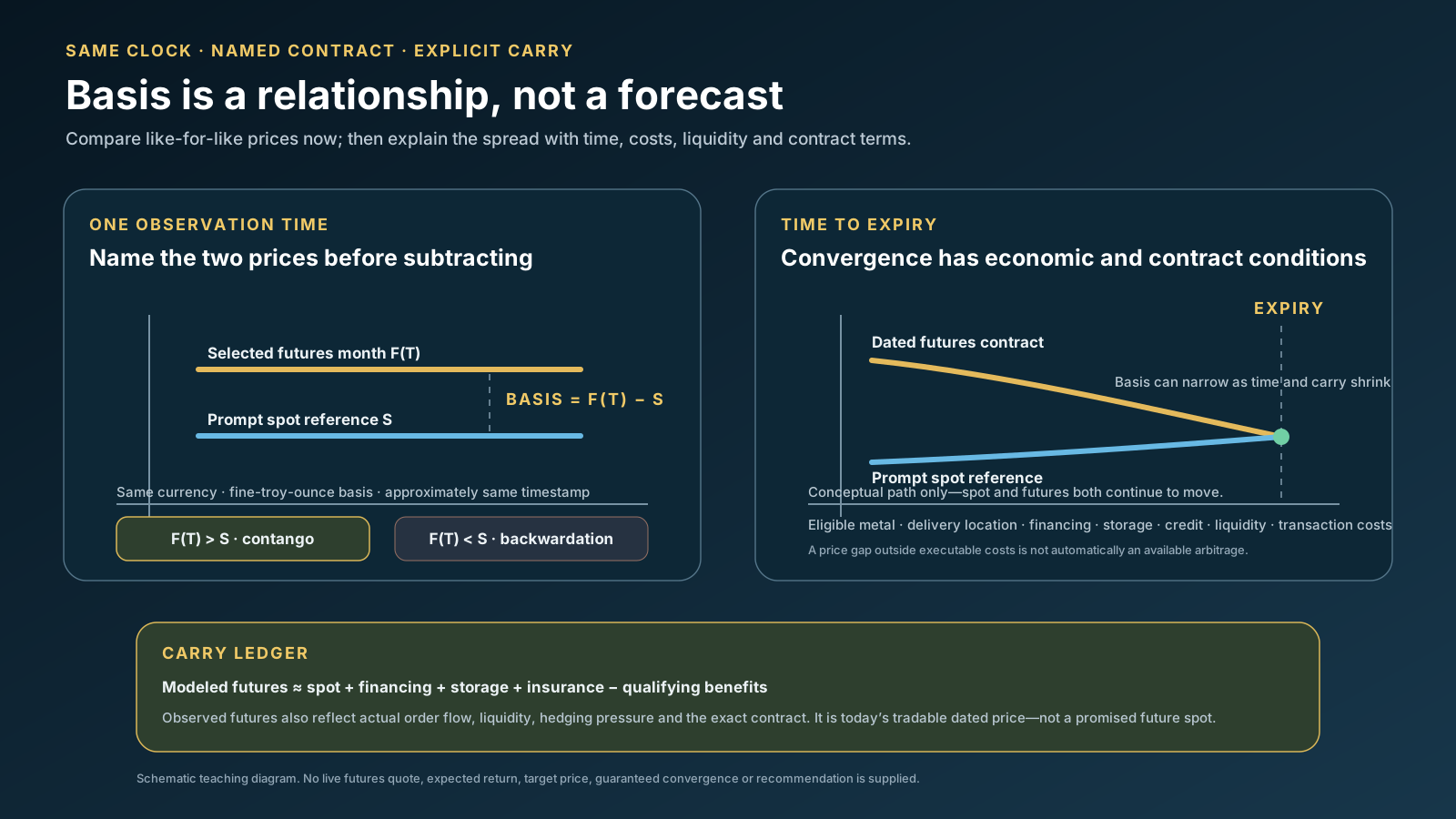
BASIS AND CONVERGENCE MAP
Compare the same clock first, then explain what can close the spread
The left panel defines basis from a compatible spot reference and one named delivery month observed at approximately the same time. The right panel shows why time, carry, eligible delivery and executable costs matter as expiry approaches; it is a relationship map, not a predicted price path.
INTERACTIVE BASIS WORKSHEET
Compare a live spot reference with a verified futures quote
GoldObserve supplies a source-labelled spot reference but does not reproduce licensed futures data. Enter a same-time USD-per-troy-ounce contract quote, months to expiry and explicit carry costs. The tool calculates basis, annualized basis, a simple cost-of-carry estimate and the remaining spread.
Price reference
Shows the source and observation time of the metal price used here. Product premiums, dealer quotes and taxes are separate.
- Source
- No provider
- Observed
- Observation time unavailable
- Age
- Checking age…
- Delivery
- No data layer available
Checking the current market reference.
Enter a same-time futures quote and explicit carry assumptions
The tool never invents a futures price. Use a verified USD-per-troy-ounce quote for the contract month being studied.
Spot and futures prices should be captured at approximately the same time and use USD per troy ounce.
Educational comparison only. Futures involve leverage, margin and contract-specific obligations and can lose more than the amount initially posted. This tool is not investment or trading advice.
DIRECT COMPARISON
Spot and futures answer different questions
THE BASIS
How to calculate the difference correctly
A positive basis means the selected futures contract is above spot; a negative basis means it is below spot.
This is a simple rate used for comparison. It is not a compound investment return and does not include transaction friction.
Capture both quotes at approximately the same time, use the same currency and troy-ounce basis, and identify the exact futures month. Comparing a live spot quote with yesterday’s futures settlement creates a timing mismatch that can be larger than the basis being studied.
COST OF CARRY
Why futures often trade above spot
A simplified cash-and-carry model starts with the cost of buying gold now and holding it until futures delivery. Financing ties up capital; vaulting and insurance add costs. In some commodities, holding the physical asset may also provide a convenience benefit. Gold’s deep above-ground stock and financing market make carry relationships important, but real execution still depends on eligible bars, credit terms, settlement location and contract rules.
The interactive tool uses a simple year fraction. Professional valuation may use exact dates, compounding, lease rates and contract-specific delivery economics.
CURVE LANGUAGE
Contango and backwardation describe a relationship, not a trade signal
Often consistent with positive net carry, but the size must be compared with time, funding and storage.
Can reflect tight prompt demand, contract positioning, liquidity or other market frictions.
A near-zero dollar difference can still be meaningful for a short-dated contract after costs.
Each listed delivery month has its own price, liquidity and time-to-expiry.
The curve state can change without spot moving if a particular contract’s liquidity, roll activity or delivery economics change. Always name the month instead of saying “gold futures are in contango” without defining the comparison.
WORKED EXAMPLE
A futures premium can be explained entirely by carry
Use the same timestamp and a US-dollar price per troy ounce.
The basis is +$60, or +2.5% of spot.
Scaling 2.5% across six months produces a simple annualized basis of 5%.
If financing is 4.5% and storage is 0.5% annually, six-month modeled carry is $60 and the illustrative futures value is also $2,460.
This does not prove an arbitrage exists. Bid-ask spreads, transaction costs, financing availability, margin, taxes, delivery eligibility and exact settlement dates can remove the apparent return.
WHY FUTURES ARE NOT FORECASTS
Today’s contract price is an executable market relationship
CONTRACT REALITY
Margin and delivery make futures different from owning a coin
A futures trader posts a performance bond rather than paying the full notional value. Gains and losses are settled through variation margin, so adverse moves can require additional cash before expiry. The standard COMEX Gold futures contract represents a much larger exposure than a one-ounce retail product, although CME also lists smaller contracts. Contract size, minimum price fluctuation, trading termination and delivery procedures belong to the exact product specification.
CME Group identifies its Gold futures market as a regulated, centrally cleared venue with nearly 23-hour weekday access. Its precious-metals overview emphasizes central price discovery and transparent exchange pricing. These descriptions do not remove leverage, liquidity or delivery risk for an individual position.
PRICE CONNECTION
Arbitrage usually keeps equivalent exposures related
If a deliverable futures contract becomes expensive relative to spot plus carry, a qualified participant may be able to buy and finance eligible gold while selling the futures. If futures become unusually cheap, the reverse relationship may attract other trades. Those actions can pull prices back toward an economically consistent range, but “equivalent” is doing substantial work: location, bar eligibility, credit, delivery timing, transaction costs and balance-sheet capacity all matter.
The LBMA Gold Price is a separate twice-daily London benchmark auction. It should not be substituted automatically for a same-time OTC spot quote when calculating a live futures basis.
ANALYSIS CHECKLIST
Before interpreting a spot-futures spread
01Identify the exact futures symbol and delivery month.
02Capture spot and futures at approximately the same timestamp.
03Confirm both prices use US dollars per troy ounce.
04Calculate exact time to expiry instead of using a vague “six months.”
05Estimate real financing, storage, insurance and transaction costs.
06Check liquidity, bid-ask spreads, margin and delivery eligibility before calling a spread executable.
PRIMARY SOURCES & METHOD
Definitions and limitations used on this page
- CME Group Gold futures for the current product overview and exchange-trading context.
- CME Group precious metals for centralized futures price discovery, clearing and product structure.
- CFTC futures glossary for regulatory-market terminology.
- GoldObserve data methodology for the live spot source, unit normalization and unavailable behavior.
GoldObserve supplies its own source-labelled spot reference and requires the reader to enter a licensed or otherwise authorized futures quote. The simple carry model excludes lease rates, exact day count, compounding, taxes, margin funding, delivery options and contract-specific adjustments.
RELATED GUIDES & DATA
Continue through the gold price foundations cluster
FAQ
Spot gold and futures questions
What is the difference between spot gold and gold futures?
Spot is a wholesale reference for prompt settlement. A futures quote belongs to a standardized contract for a specified delivery month.
Does a gold futures price predict the future spot price?
Not directly. Cost of carry, hedging demand, liquidity and contract terms can separate the futures price from a pure expectation of future spot.
What are contango and backwardation in gold?
Contango means the selected futures contract is above spot; backwardation means it is below spot. The basis must be interpreted with time and carry costs.
Do I receive physical gold when a futures contract expires?
Delivery depends on the contract, position and exchange procedures. Many market participants offset or roll positions before delivery, and taking delivery requires operational eligibility.
Why does the calculator require a manual futures quote?
Futures market data can carry licensing and redistribution restrictions. The page does not invent or republish a contract price without an authorized source.