THE SHORT ANSWER
Test the claim in layers; never let one trick become proof
Safe gold-coin testing begins with the exact official specification and an accountable seller. Weight, diameter, design and security features can expose inconsistencies, but matching them does not prove the interior metal. Preserve return rights, avoid destructive tests and escalate meaningful transactions to qualified non-destructive verification. The strongest result is a chain of independent evidence, not a phone app saying “pass.”
Exact year, size, finish and source.
Weight, diameter and documented features.
Qualified non-destructive methods.
Seller, invoice and return rights matter.
VISUAL DECISION PATH
Build independent evidence before escalating the test
Read the ladder from left to right. Each stage asks a narrower question and carries a different blind spot: recourse identifies who stands behind the sale, specifications define what should be measured, screens look for conflicts, and professional instruments assess only the material or depth they are designed to examine.
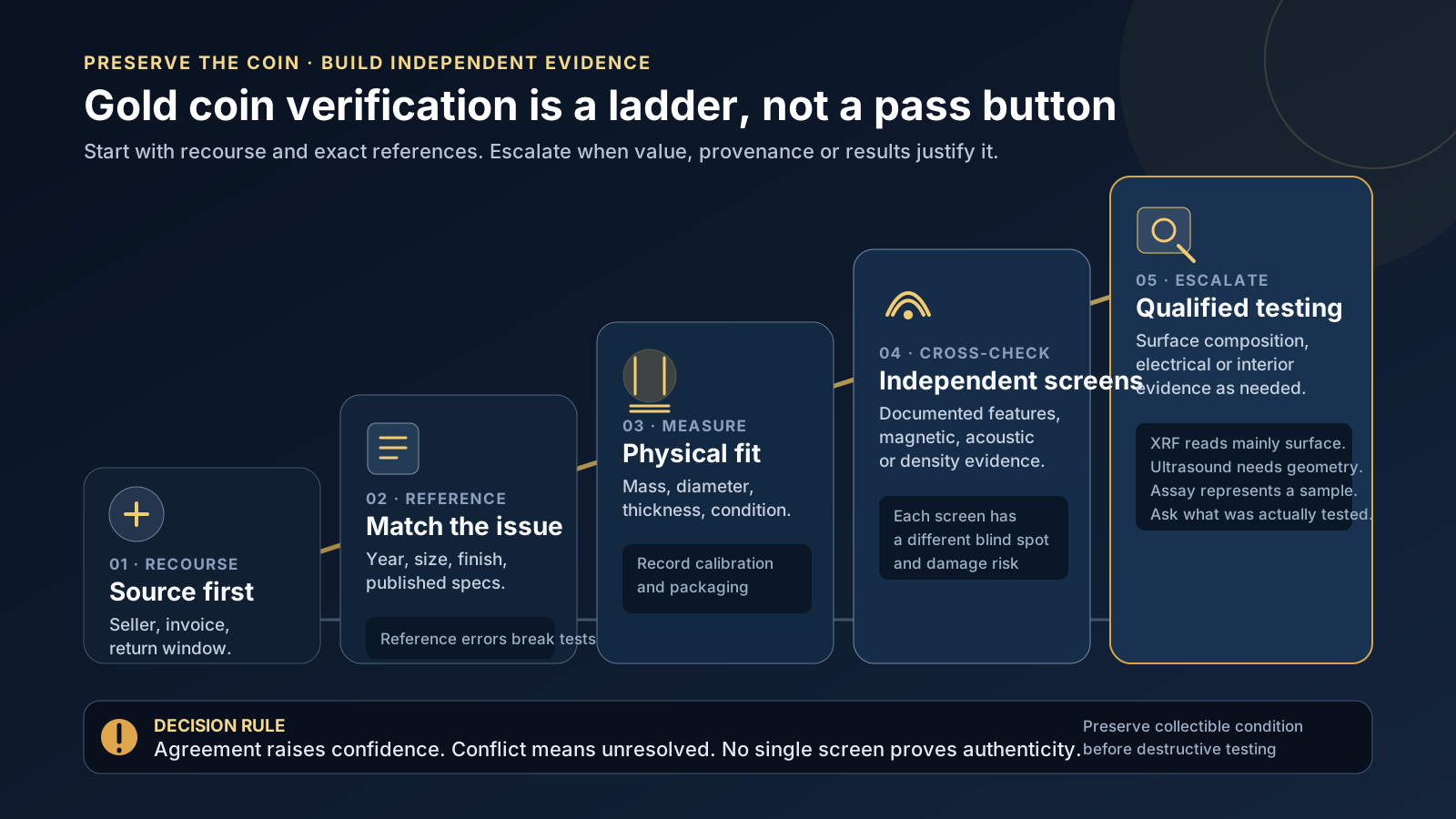
Method boundary: This is a decision framework, not an authentication certificate. Do not copy official coin artwork, treat one matching feature as proof, or damage a collectible coin merely to complete the ladder. Conflicting results should remain unresolved until an appropriate qualified test or return process.
EVIDENCE LADDER
Seven checks from listing to professional verification
Identity, reputation, written guarantee, payment protection, invoice and return terms come before the coin.
Issuer, year, denomination, size, finish, design type and packaging determine which reference applies.
Use Mint-published gross weight, diameter, fineness and fine-metal content, not a marketplace description.
Check inscriptions, edge, relief and year-specific security features under appropriate magnification.
Record instruments, resolution, calibration, packaging and repeated measurements.
Higher value, weak provenance or conflicting results justify qualified professional testing.
Keep invoice, photos, serial or packaging references, test report and acceptance or rejection reason.
INTERACTIVE SCREEN
Start with official weight and diameter, then keep going
The worksheet calculates numerical differences for current U.S. Mint Eagle and Buffalo specifications and the Royal Canadian Mint's 2026 one-ounce Maple Leaf. It does not create official tolerances or authenticate the coin. A user-entered tolerance is only a documented screening threshold.
Difference = measured value - published nominal value. The tool does not supply Mint manufacturing tolerances. Any tolerance is entered by the user and should reflect calibrated instrument uncertainty plus appropriate professional guidance.
Open the official specification source
A matching weight and diameter do not prove authenticity. A mismatch may also reflect the wrong year, finish, size, damaged coin, packaging, instrument error or an incorrect measurement method. Do not drill, file, cut, acid-test or otherwise damage a coin based on this worksheet.
WHAT EACH TEST CAN AND CANNOT SAY
Interpret the method before interpreting the result
| Method | Useful for | Cannot establish alone | Main risk |
|---|---|---|---|
| Weight and dimensions | Rejecting obvious physical mismatches | Interior composition or legal ownership | Wrong reference, packaging or poor instruments |
| Visual and edge inspection | Finding missing or incorrect documented features | Metal content beneath the surface | Wrong year/type comparison and subjective judgment |
| Magnetic behavior | Exposing some incompatible materials | That a non-magnetic coin is gold | False reassurance and nearby metal |
| Sound comparison | Adding a product-specific acoustic screen | Purity or authenticity | Damage, holders, microphones and alloy differences |
| XRF | Professional surface-composition analysis | Full interior composition in every geometry | Calibration, plating and operator interpretation |
| Mint-specific database system | Checking eligible registered products | Ownership, grade, tax or resale price | Product/year eligibility and authorized equipment |
COMMON HOME-TEST FAILURES
A clever test can create dangerous confidence
Gold is not magnetic, but many non-gold materials are also non-magnetic. Sound depends on geometry, alloy, wear, strike, holder, surface and recording hardware. Hydrostatic density can be distorted by bubbles, surface tension, fixtures and temperature. A phone app can compare a recording or image without knowing whether the specimen's interior matches the surface.
The error is not using a simple screen; the error is upgrading it into proof. Use inexpensive checks to decide whether more evidence is needed. Do not use them to waive seller diligence or to justify irreversible payment. When independent checks conflict, the correct output is “unresolved,” not whichever result supports the purchase.
The U.S. Mint specifically advises extra scrutiny when bullion is offered below the current market price. Urgency, secrecy, untraceable payment and refusal to permit reasonable verification are transaction risks even when the coin appears convincing.
MINT-SPECIFIC EXAMPLES
Security features are versioned product facts
Gold Maple Leafs dated 2014 and later are eligible for the Royal Canadian Mint's Bullion DNA process. Approved dealers use specialized imaging to compare the micro-engraved security mark with the Mint's secure database. The current coin also uses precise radial lines and a year micro-mark. That is stronger than merely seeing a maple leaf, but it applies only through the documented process.
The Royal Mint documents a latent padlock-to-trident image, surface-wave animation, micro-text and tincture lines on current Britannia bullion. The redesigned one-ounce Gold Eagle documents a reeded-edge variation. These details change by product and year. Before deciding a feature is missing, confirm whether the feature belongs on that exact issue.
WHEN TO USE A PROFESSIONAL
The transaction value should determine the evidence budget
Document the product, invoice, guarantee and basic non-destructive screens.
Require stronger payment protection and independent verification before settlement.
Metal tests do not appraise date, condition, variety, holder or provenance.
Pause the transaction and use an appropriate qualified test or return process.
Professional methods are not magic. XRF is predominantly a surface analysis and depends on configuration and calibration. Electrical and ultrasonic techniques depend on geometry and reference data. Mint database systems cover specified eligible products. Ask which method was used, what part of the coin it evaluates, who operated it and what conclusion the written result actually supports.
BUYER CHECKLIST
Preserve evidence and recourse before transferring money
- Record seller identity, reputation, contact details and written guarantee.
- Confirm the listing is bullion, proof, graded, commemorative or another product category.
- Match year, denomination, weight, diameter, fineness and design to a direct official source.
- Record the spot reference and premium; investigate implausible below-market pricing.
- Use calibrated non-destructive measurements and note packaging.
- Inspect year-specific security features without damaging the surface.
- Escalate high-value, private or conflicting cases before irreversible payment.
- Retain invoice, photographs, results, return deadline and final decision.
PRIMARY SOURCES
Official guidance used for the verification workflow
- U.S. Mint Bullion Consumer Awareness for seller research, below-market scrutiny and physical specification checks.
- U.S. Mint Bullion Coin Programs for Gold Eagle and Gold Buffalo composition and dimensions.
- Royal Canadian Mint Bullion DNA and dealer guide for eligible products and the database-backed process.
- Royal Mint Britannia security features for latent image, micro-text, tincture lines and surface animation.
FREQUENTLY ASKED QUESTIONS
Gold coin testing questions
What is the safest first test for a gold coin?
Start with identification and documentation: exact coin, year, size, finish, official source and seller. Then use non-destructive weight, diameter and documented visual-feature checks with suitable instruments. No single home test is conclusive.
Does a magnet prove whether a gold coin is real?
No. A magnetic response can reveal some obvious mismatches, but a non-magnetic result does not prove gold content. Holders, nearby metal, instrument strength and counterfeit construction can affect interpretation.
Is the ping test reliable?
Sound can be one comparison input for some coins, but microphones, surfaces, holders, strikes, wear and alloy differences affect recordings. A sound match is not proof, and deliberately striking or dropping a coin can damage it.
Should I acid-test a bullion coin?
Not as a routine first-line check. Filing and acid can permanently damage a genuine coin and collector premium. Material transactions should use appropriate professional non-destructive testing and accountable counterparties.
What professional tests are used for gold coins?
Depending on the product and risk, professionals may combine calibrated dimensions and mass, electrical or ultrasonic methods, X-ray fluorescence for surface composition, mint-specific systems such as Bullion DNA, and expert visual examination. Each method has limits and should be interpreted by a qualified operator.
Can XRF prove a coin is solid gold?
XRF is valuable for surface-composition analysis but is not automatically a complete interior assay. Geometry, plating, calibration and instrument configuration matter. A professional may combine methods when interior substitution is a concern.