THE SHORT ANSWER
A reserve number combines metal, control, price and accounting
Central bank gold reserves are monetary gold controlled by the monetary authorities and available as a reserve asset. A published number may describe a physical quantity, a balance-sheet value or a share of total reserves. Those are different measurements. A value increase does not prove a purchase: gold prices, exchange rates, reclassifications and revisions can change the reported value while tonnes remain unchanged.
The amount of fine gold, independent of price.
Requires a date, currency and accounting basis.
Both sides need the same date and valuation basis.
Separate transactions from price, FX and revisions.

RESERVE VALUE CALCULATOR
Convert tonnes into market value and test a pure revaluation
Enter a monetary-gold quantity, market price and total official reserves measured in one reporting currency. The scenario holds the fine-gold quantity and every non-gold reserve asset constant, so the result isolates what a gold-price move would do to value and portfolio share. It is an accounting sensitivity, not a policy forecast.
Illustrative inputs only. These defaults are not a country's holdings. Replace them with same-date official quantity, price or valuation basis, and total reserves. This model uses market value; a statutory or published book value can differ.
Fine ounces = metric tonnes x (1,000,000 / 31.1034768). Gold market value = fine ounces x price per fine troy ounce. Gold share = gold market value / total official reserves. The scenario changes only the gold price and is not a forecast.
VALUATION FORK
Keep the official balance and market scenario on separate branches
The same fine-gold quantity can support a statutory or accounting value and a dated market-value scenario. Keeping those branches separate prevents a revaluation exercise from being mistaken for a sale, a cash reserve or a forecast.
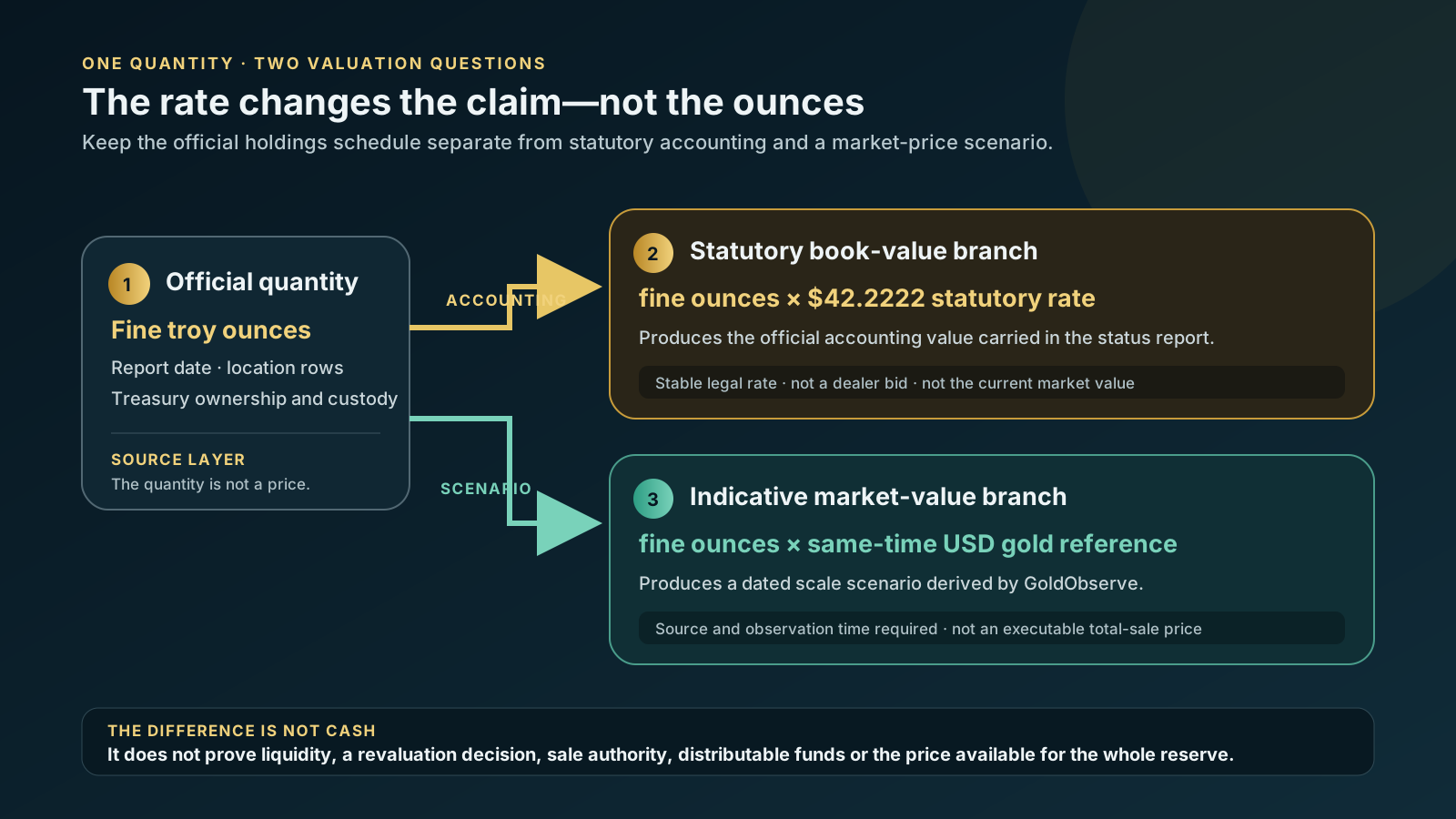
Method boundary: The diagram is a valuation framework. The reporting authority's definition, valuation date, price source, currency convention and accounting treatment control any official comparison.
DEFINITION
Not every official gold holding is automatically a reserve asset
The IMF's Balance of Payments and International Investment Position Manual defines reserve assets as external assets that are readily available to and controlled by monetary authorities. Monetary gold is gold to which those authorities have title and hold as reserve assets. The definition covers bullion with a minimum fineness of 995 parts per thousand, allocated accounts, and qualifying unallocated gold accounts with nonresidents that give title to delivery of gold.
This boundary matters. Gold owned by another government body, committed in a transaction, unavailable to the authority, or reported outside reserve assets may need different treatment. Read the reporting institution's notes rather than adding every official-sector gold item into one total.
UNIT CONVERSION
One metric tonne contains 32,150.7466 fine troy ounces
“Fine” refers to the pure-gold content, not gross bar weight. A Good Delivery bar can weigh roughly 400 gross troy ounces and still require its assay to calculate fine weight. Published reserve tonnes often refer to fine gold, but verify the dataset metadata before applying the conversion. Never use the 28.3495-gram avoirdupois ounce.
RESERVE SHARE
The denominator can reverse the conclusion
For gold's share of official reserves, divide gold value by total official reserve assets on a compatible market-value basis. Official reserves can include monetary gold, SDR holdings, the reserve position in the IMF, foreign currency and deposits, securities, derivatives and other claims. A table labelled “foreign-exchange reserves” may exclude gold and is not automatically the right denominator.
If a gold price increase lifts the numerator while non-gold assets are constant, it also lifts total reserves. Dividing the higher gold value by an unchanged old denominator overstates the new share. The calculator rebuilds the denominator as unchanged non-gold reserves plus revalued gold.
CHANGE DECOMPOSITION
A value change has at least four possible causes
Purchases and sales change the quantity, subject to settlement and reporting treatment.
A new valuation price changes market value even when the fine ounces do not move.
The same gold value can move in a local reporting currency as exchange rates change.
Method, coverage, swaps, corrections or late reports can alter the series.
The interpretation reverses when quantity is flat: a higher value or reserve share is then evidence of valuation mechanics, not evidence that the authority bought metal. To identify purchases, compare same-definition quantity observations and confirm transactions or official commentary.
CUSTODY AND TITLE
Where the bars sit is not the same as who owns them
Central banks can keep gold domestically or use a custodian near a major trading market. The Bank of England, for example, provides gold custody to the UK government and other central banks. It explains that allocated custody means the customer retains title to specific bars; customer gold therefore does not appear as the Bank's own asset on its balance sheet.
ACCOUNTING
Market value and balance-sheet value can tell different stories
The ECB's annual accounts provide a concrete example of market revaluation: gold and gold receivables are valued at market rates, and unrealized appreciation can be recorded in a gold revaluation account rather than recognized as ordinary income. That treatment is useful evidence of how valuation can change equity-like accounts without a sale, but it is not a universal accounting rule for every central bank.
When comparing a calculator result with an official statement, check the valuation date, price source, currency translation, treatment of unrealized gains and losses, and whether the institution reports market value, historical or statutory value. A difference is not necessarily an error.
WHY HOLD GOLD
Gold can diversify issuer risk, but it is not a free hedge
- No issuer liability for bullion: a bar is not a promise by a foreign government or bank, though custody and transaction structures can add counterparties.
- Market liquidity: gold can be mobilized in established bullion markets, but location, form, legal arrangements and market conditions affect speed and cost.
- Diversification: gold's drivers differ from many sovereign and currency assets, but correlations are unstable and price losses remain possible.
- Confidence and resilience: authorities may value a globally recognized reserve asset, while still bearing storage, security, insurance and opportunity costs.
Gold does not guarantee currency stability, prevent a balance-of-payments crisis or produce contractual interest. The optimal reserve composition depends on the authority's liabilities, intervention needs, liquidity horizon, risk tolerance and legal mandate.
DATA AUDIT
Use this checklist before comparing countries or dates
01Identify the reporting central bank, finance ministry or statistical authority and the release date.
02Confirm whether the observation is fine tonnes, fine troy ounces, gross bar weight or a currency value.
03Record the observation date, valuation price, reporting currency and exchange-rate convention.
04Define the denominator: total official reserve assets, foreign-exchange reserves, or another aggregate.
05Separate ownership from custody and inspect allocated, unallocated, swap, lease and encumbrance notes.
06Check revisions, breaks in series and whether a value change is supported by a quantity change.
PRIMARY SOURCES AND BOUNDARY
This guide explains method; it does not reproduce a country ranking
- IMF BPM6, Chapter 6 for reserve assets, monetary gold, bullion fineness and allocated/unallocated account definitions.
- IMF International Reserves template guidelines for the composition and disclosure of official reserve assets.
- IMF International Reserves and Foreign Currency Liquidity dataset for standardized official reserve information and metadata.
- Bank of England gold custody guide for the allocated-custody, specific-bar and customer-title example.
- ECB Annual Accounts 2025 and annual accounts FAQ for a documented market-revaluation example.
GoldObserve does not publish or relabel a live country-holdings table on this page, claim that the default inputs describe any authority, infer purchases from value alone, or provide reserve-management recommendations. For current holdings, use the reporting authority and licensed datasets under their stated terms.
RELATED RESEARCH
Connect reserve management to the wider gold framework
FAQ
Central bank gold reserve questions
Why do central banks hold gold reserves?
Reasons can include diversification, liquidity, confidence and resilience because gold bullion is not another issuer's liability. Those benefits do not eliminate price volatility, storage cost, liquidity constraints or the opportunity cost of holding a non-yielding asset.
What counts as monetary gold?
Under the IMF balance-of-payments framework, monetary gold is gold to which monetary authorities have title and which is held as reserve assets. It includes qualifying gold bullion of at least 995 parts per thousand and certain allocated or unallocated gold accounts. Control and ready availability are part of the reserve-asset test.
How are central bank gold reserves measured?
Quantities are commonly reported in fine troy ounces or metric tonnes, while balance sheets and reserve datasets also report a value in a chosen currency. Quantity, valuation date, price basis and exchange rate must be kept separate.
Does a higher gold reserve value mean the central bank bought gold?
No. The value can rise because the gold price increased or because the reporting currency changed. A purchase conclusion needs quantity or transaction data, consistent dates and revision notes.
How do I calculate gold's share of official reserves?
Divide the market value of monetary gold by total official reserve assets measured on the same date, in the same currency and on a compatible valuation basis. Do not silently substitute foreign-exchange reserves excluding gold for the denominator.
Where do central banks store gold?
Gold can be held in domestic vaults or with external custodians that provide access to a liquid bullion market. Vault location does not by itself establish ownership. Contracts and records determine title, allocation and any encumbrance.
What is the difference between allocated and unallocated reserve gold?
Allocated custody identifies specific bars and leaves title to those bars with the customer. An unallocated account is a claim on a provider for delivery of gold. The IMF can classify qualifying unallocated accounts with nonresidents as monetary gold, but their legal and counterparty characteristics differ.
Is central bank gold the same as a gold standard?
No. Holding gold as one reserve asset does not mean the currency is legally convertible into gold at a fixed rate. A modern fiat-currency central bank can hold gold without operating a gold standard.
Where can I verify official gold reserve data?
Start with the reporting central bank or finance ministry and its financial statements. IMF International Reserves and Foreign Currency Liquidity data can provide standardized reserve information. Read the dataset metadata, valuation basis and revision notes before comparing countries or dates.