THE SHORT ANSWER
Book value is a statutory accounting amount; market value is a price scenario
The U.S. government's latest reported 261,498,926.241 fine troy ounces carry a statutory book value of $11,041,059,957.90, based on $42.2222 per ounce. Market value multiplies the same fine ounces by a same-time gold price. The second number is useful for economic scale, but it is not the balance-sheet carrying amount, an executable sale value or evidence that Treasury plans to revalue the reserve.
TWO FORMULAS
Keep the quantity fixed and change only the valuation basis
Produces approximately $11.041 billion, subject to official row-level rounding.
Changes with the chosen source and timestamp. It is not stored in the monthly Fiscal Data rows.
Use the U.S. Treasury gold reserve explorer to enter a sourced market price, inspect the provider and observation time, and compare the result with official book value.
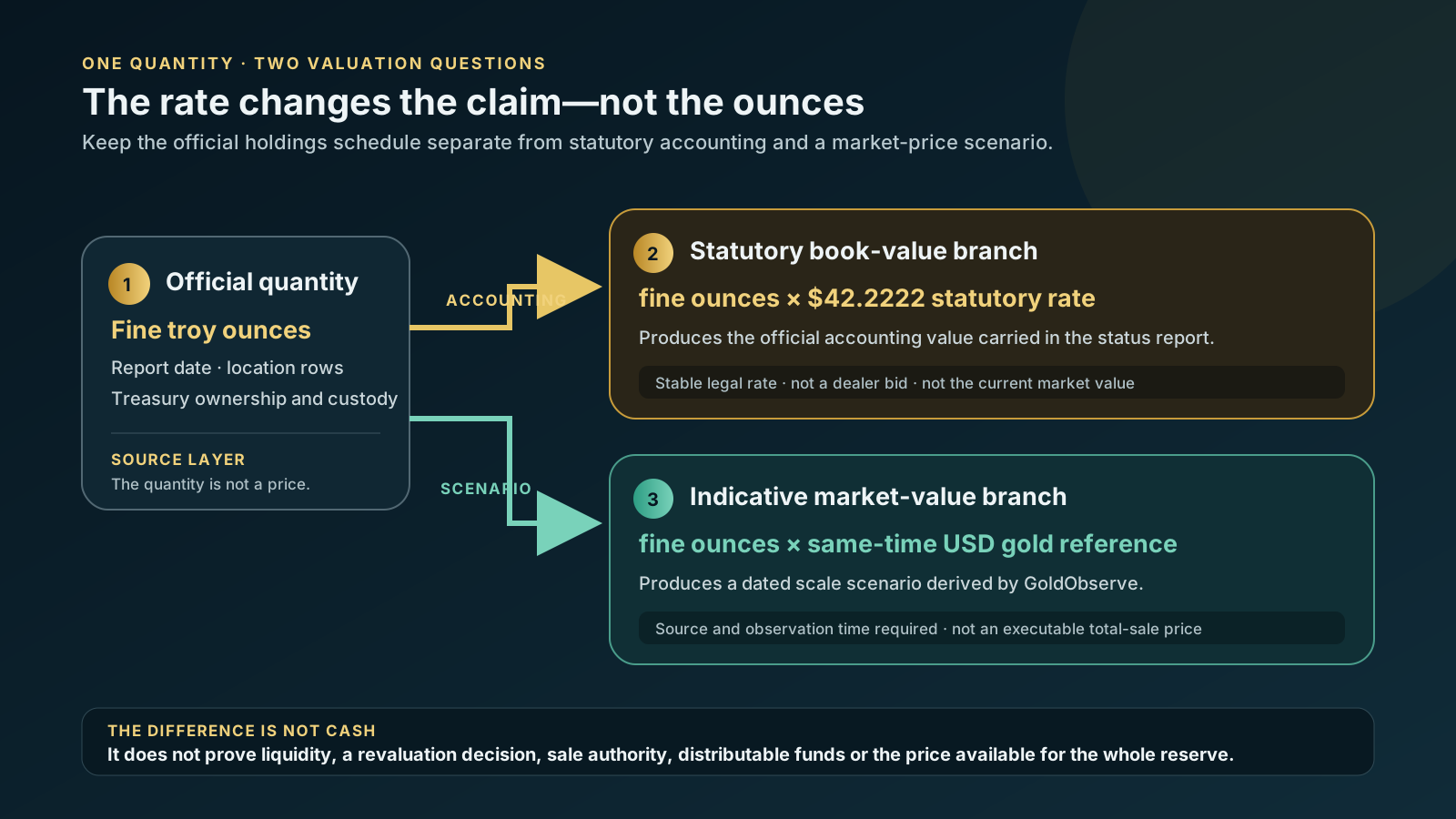
Method boundary: The lower branch is a dated scale scenario, not an executable sale, accounting entry, policy decision, liquidity estimate or forecast.
WHY THE NUMBERS DIVERGE
The statutory rate is stable while market gold moves
HOW TO BUILD A DEFENSIBLE MARKET VALUE
Match units, date, source and scope
- 01Use official fine troy ounces
Do not substitute metric tonnes rounded to one decimal or approximate bar count.
- 02Choose one record date
State whether the quantity is current month-end, fiscal year-end or another official period.
- 03Choose one market observation
Record USD per troy ounce, provider and timestamp.
- 04Multiply without false precision
Input data can contain many decimals, but a market-value scenario should reflect price and execution uncertainty.
- 05Label exclusions
No sale authority, market impact, fees, liquidity, policy or custody change is assumed.
COMMON ERRORS
Five shortcuts that produce misleading reserve values
The official schedule reports fine troy ounces.
Purity is already normalized.A dealer coin price includes product premium.
It is not a wholesale gold benchmark.A scenario can do this only when the mismatch is explicit.
It is not a same-date historical valuation.No acquisition-cost, realization or legal event is modeled.
Book-to-market difference is not cash.REVALUATION CLAIMS
A mathematical revaluation is not a policy forecast
Changing the accounting price in a spreadsheet can produce a larger asset value. It cannot establish that federal law will change, that gold certificates will be altered, that the reserve will be sold or pledged, or that any balance-sheet effect would fund a particular program. Those conclusions require legal authority, enacted policy and accounting treatment—not only arithmetic.
The reserve is also linked to gold certificates issued to Federal Reserve Banks at the statutory rate. Any serious policy analysis must account for the related liability and consolidated federal reporting instead of treating the gross market-value difference as an unencumbered asset.
METHODOLOGY
Reconcile the published rows before applying any price
- Sum the eight official Fiscal Data rows for one record date.
- Confirm that official book value divided by fine troy ounces is consistent with the statutory rate, allowing for row-level cents.
- Use the same official quantity for book and market comparisons.
- Use a source-labelled USD-per-fine-troy-ounce market observation or a clearly labelled manual scenario.
- Do not treat price appreciation as a purchase, sale, income item or realized gain.
- Do not present market value as the official monthly book value or as available sale proceeds.
PRIMARY SOURCES
Official quantity, statutory basis and audited disclosures
- Fiscal Data U.S. Government Gold Reserve dataset for monthly fine ounces and book values.
- Bureau of the Fiscal Service Gold Report for the $42.2222 rate and schedule scope.
- Treasury OIG-26-021 for FY2025 Mint custody, statutory value and market-value disclosure.
- Treasury OIG-26-004 for Federal Reserve Bank-held U.S. gold schedules.
FAQ
U.S. gold reserve valuation questions
Why is U.S. gold recorded at $42.2222 per ounce?
Treasury uses the statutory rate established under federal law for the carrying value of U.S. government gold. The rate is an accounting basis and does not move with market gold prices.
What is the current book value of U.S. government gold?
The latest Fiscal Data rows total $11,041,059,957.90 as of 2026-06-30. The figure is the sum of the official eight-row schedule.
How do I calculate market value?
Multiply the official fine troy ounces by a USD gold price observed at a stated time. Do not use gross bar weight, a per-gram quote without conversion, or a price from a different date without disclosure.
Is market value the amount Treasury would receive in a sale?
No. A multiplication scenario ignores execution, market impact, legal authority, custody constraints, policy and whether any sale would occur. It is a scale estimate, not realizable proceeds.
Does the gap between market and book value create spendable money?
No. The difference is not cash and does not itself authorize revaluation, monetization, distribution or debt reduction. Those are legal and policy questions beyond a valuation calculation.
Can a book-value increase prove the government bought gold?
Not by itself. First check whether fine troy ounces changed, whether a row was revised, and whether the same statutory rate was applied. Quantity is the cleaner purchase-or-transfer signal, but motive still requires separate evidence.