THE SHORT ANSWER
Austria exempts qualifying investment gold, not every object made of gold
Under the EU investment-gold regime applied in Austria, qualifying bars and wafers generally require accepted bullion-market weights and at least 995 fineness. Coins use a separate four-part test. Exemption depends on the exact product and transaction; the label bullion is not enough.
PRODUCT DECISION MAP
Apply one complete product test before reading the invoice
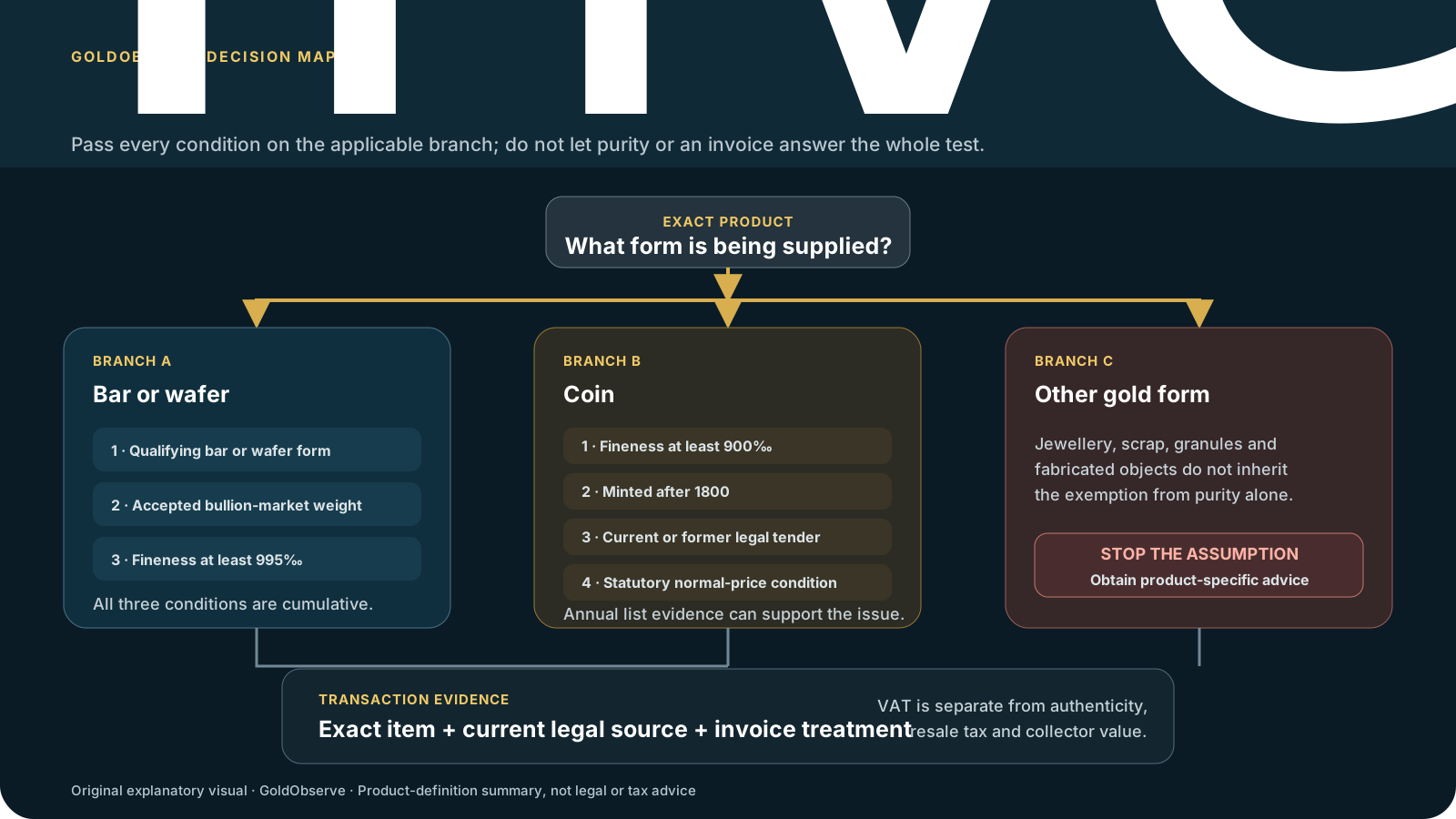
The Austrian exemption begins with the EU investment-gold definition. Identify whether the exact item is a bar or wafer, a coin, or another form; only then apply the cumulative conditions and reconcile the seller's treatment.
BAR TEST
Accepted market weight plus at least 995 fineness
Article 344 of the VAT Directive defines investment-gold bars or wafers by form, accepted bullion-market weight and purity of at least 995 thousandths. Jewellery, scrap, granules or an unusual fabricated object should not be assumed to qualify merely because an assay shows high purity.
Investment format, not jewellery.
Document the product standard.
Reliable refiner or assay evidence.
Invoice and seller treatment matter.
COIN TEST
A qualifying coin must satisfy all four statutory conditions
At least 900 thousandths.
Minted after 1800.
Current or former legal tender in its origin country.
Normally sold within the Directive's contained-gold premium boundary.
The annually published EU coin list provides practical certainty for listed coins for the relevant year, while absence from a list is not a licence to guess. Obtain current professional guidance for uncommon issues.
COMMON ERRORS
Four shortcuts produce bad VAT conclusions
- Purity alone: a high assay does not establish investment form or coin status.
- Legal tender alone: denomination does not prove all coin conditions.
- Dealer category alone: a website menu label is not statutory evidence.
- VAT equals all tax: a later private sale has a separate income-tax analysis.
PRIMARY SOURCES
Official rules and market-role evidence
- EU VAT Directive, Articles 344 and 346 for the investment-gold definition and exemption framework.
- Austrian Federal Ministry of Finance VAT guidance for the Austrian exemption and annual coin-list treatment.
- Austrian Mint investment-products guidance for qualifying gold formats and its own sales process.
- Austrian government business portal AML guidance for trader duties where cash payments reach the stated threshold.
Sources were reviewed July 31, 2026. Dealer procedures and tax outcomes can change with the product, customer, payment route and facts; confirm current terms before acting.
FAQ
Austrian investment-gold VAT questions
What purity must an investment-gold bar have?
The EU definition covers a bar or wafer of a weight accepted by bullion markets and purity of at least 995 thousandths.
What purity must an investment-gold coin have?
The coin test includes purity of at least 900 thousandths, minting after 1800, current or former legal-tender status and a normal selling-price condition tied to contained gold.
Is every gold coin VAT-exempt?
No. A collectible or other coin can fail one or more statutory criteria. Check the exact issue and current guidance.
Does VAT exemption remove income tax?
No. VAT at acquisition and income-tax consequences on a later private sale are separate questions.